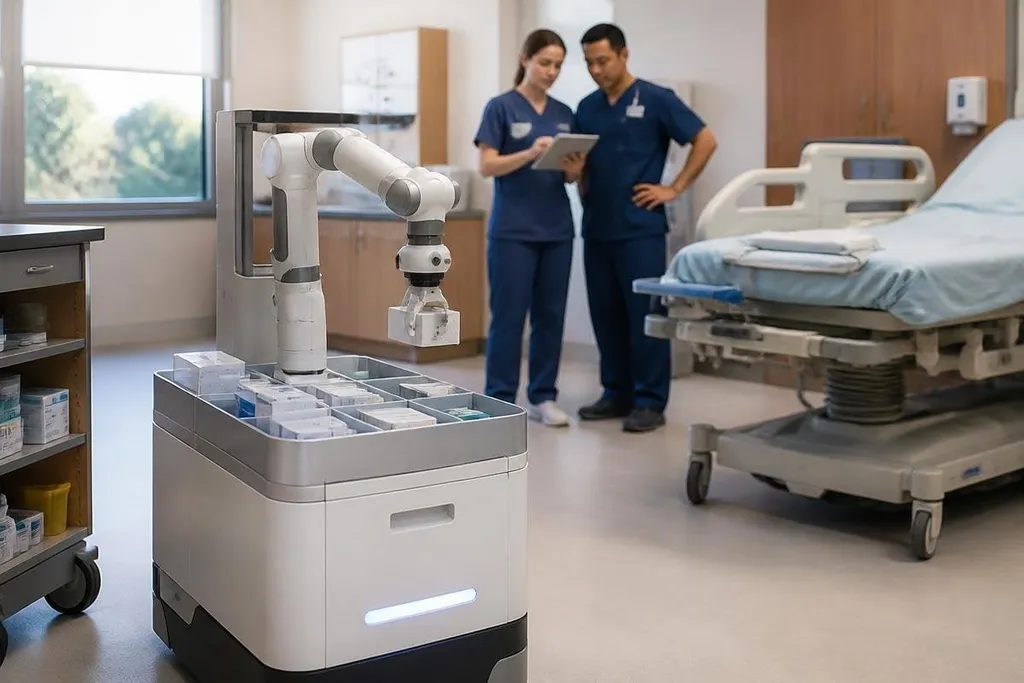
A healthcare robot may sort medicine, move a bed, guide a therapy exercise, or hold a surgical tool.
The next wave will succeed by doing narrow jobs safely, then fitting into the work already done by nurses, doctors, and technicians.
- Surgical systems control small instruments through a console, while a camera sends the view to the surgeon.
- Hospital mobile robots can carry items through corridors, but doors, lifts, people, and carts still shape the task.
- Rehab robots measure movement and add support only where the patient needs it.
Where the robots will work
Surgery, logistics, rehabilitation, and patient care need different kinds of machines. A robot built for a sterile operating room cannot be sent into a busy ward and expected to work without changes to its sensors, body, and safety controls.
Surgical robots use articulated arms, an end effector at the tool tip, and a camera. The surgeon remains responsible for the procedure. That system can filter hand movement and hold a tool in a fixed position, but it does not decide where an incision should go.
Hospital logistics robots face a less tidy setting. They may carry meals, linen, samples, or medicine between fixed points. LiDAR measures distance with laser pulses, while mapping software helps the robot locate itself. A blocked corridor can still stop the trip, so staff need a clear way to move the robot or take over.
Rehabilitation adds another layer. An exoskeleton may use motors at the hip or knee to help a person repeat a walking motion. Force sensors can measure how hard the person pushes, which lets the control system reduce help as their movement improves. The useful measure is the person’s progress, not how human the machine looks.
Safety has to fit the task
Healthcare robots work close to people who may be weak, sedated, confused, or unable to move away. That makes safe motion more than a software feature. The robot needs known limits for speed, force, contact, stopping distance, and access to the emergency stop.
A mobile robot also needs a clear handoff when its plan fails. Staff should see what blocked it, where it stopped, and what action will clear the fault. A message that says “error” leaves the hardest part to the person already carrying the workload.
The same rule applies to data. Cameras, microphones, and movement sensors may record information about patients and staff. Hospitals need to know what the robot stores, where that data goes, and who can open it. A machine that works well but creates an unclear record can add work instead of removing it.
For a hospital buyer, the useful record includes the robot’s task, trial site, staff role, and date, not only its sensor list. Reports at Robot24.com can connect those details to medical robots and the limits stated in each test. That gives the next section a practical starting point: what changes when a machine leaves a demo room and enters a ward.
The gap between a demo and a ward
A controlled demonstration removes many problems. The floor is clear, the route is known, the task starts on time, and a trained operator stands nearby. A hospital shift has none of those conditions for long.
The harder test is repeated work across a full shift. It must charge, recover from blocked routes, accept cleaning, and keep working when staff change.
A service plan also needs to name who replaces a battery, checks a sensor, or resets the software. Without that plan, a short fault can turn into a long pause.
I’d judge a healthcare robot by its failure handling before its smoothest demo. A machine that stops safely and explains the fault may help a ward more than one that moves quickly until the first unusual case.
A buying checklist for healthcare teams
Use these questions before a pilot reaches patients or busy staff areas:
- Name the task: Set one job with a clear start, finish, and human owner.
- Test the bad cases: Block routes, remove a load, interrupt power, and check the stop behavior.
- Measure staff time: Record setup, cleaning, charging, recovery, and handoff work.
- Check patient data: List every sensor, stored record, access rule, and deletion process.
- Plan service: Assign the people who handle faults, parts, software updates, and training.
The next healthcare robots will earn wider use through narrow results: fewer manual trips, repeatable therapy sessions, safer tool control, or cleaner records. The open question is how many hospitals can support the maintenance and training those machines need after the pilot ends.